
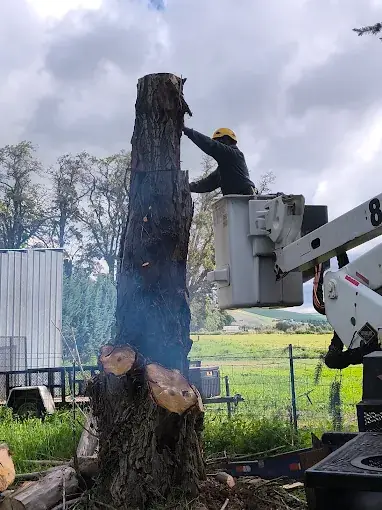
Stump Grinding for Benton City Vineyards, Fence Lines, and Acreage
Out past Kiona and the Highway 224 corridor, stumps aren't a lawn nuisance — they're in the way of a fence line, a new vine row, or a tractor pass. We grind them below grade and haul the debris, so field-edge and vineyard properties are ready to work again, not just tidy.
Fence-line and field-edge grinding
Old windbreak stumps left behind along Demoss Road and Highway 224 fence lines get in the way of new posts, mowers, and equipment. We grind them out below grade so a new fence line or a tractor pass doesn't hit buried wood or a hidden root flare down the line.
Field-edge grinding often means dealing with a stump every few feet down a long row rather than a single stump in a yard. We bring equipment sized for that pace instead of treating each one as a separate trip.
Clearing after cottonwood and poplar removal
A cottonwood or Lombardy poplar removal along the Yakima or a windbreak row isn't finished until the stump's gone. Sandy river-bottom soil actually makes grinding faster in most cases, and we can knock out a whole windbreak's worth of stumps in one visit rather than scheduling separate trips for removal and grinding.
Vineyard and winery grade prep
Red Mountain AVA properties replacing a dead tree with a new vine row or landscaping need the stump gone completely — no root flare left to catch equipment or interfere with irrigation trenching. We grind to depth and can haul every chip if the site needs to be clean for planting right away.
Timing matters here too — we can schedule grinding work around a vineyard's planting calendar so the ground is ready exactly when the crew needs it, not weeks ahead or behind.
Russian olive and canal-side stump removal
Russian olive along irrigation canals resprouts aggressively if the stump is left whole. Grinding it out, rather than just cutting it down, is the difference between a one-time job and fighting the same growth again next season along the same canal bank.
Kiona and Old Benton City lot grinding
Older lots in Kiona and Old Benton City often have stumps sitting closer to a foundation, a septic line, or a shared driveway than anything out on the open ag land. We take extra care locating utilities and septic infrastructure before grinding in these tighter, older lots, since the buried lines here are less predictable than a newer rural property's layout.
These lots also tend to have a stump or two left from a tree that came down years before we ever got the call — old cuts, partially rotted wood, root systems tangled with sidewalk or foundation edges. We size the grinder and depth to whatever's actually in the ground, not just what's visible above it.
Grinding near Horn Rapids Dam and river-adjacent properties
Stumps near Horn Rapids Dam and the river corridor sit in a mix of sandy fill and river-deposited soil that can hide old flood debris or buried rock. We check the ground before committing the grinder to depth, since a hidden obstruction can slow the job or damage equipment if we don't. Properties this close to the water also tend to have volunteer stumps from cottonwood and willow that seeded in on their own, often in clusters rather than one at a time, so we plan for grinding several in one pass rather than treating each as a separate stop.
Full chip-and-haul stump cleanup
Every stump grinding job out here comes with a choice: leave the ground chips to settle back into the hole, or haul every bit off site. On vineyard and winery properties we default to full haul-off so there's nothing to interfere with new plantings or irrigation trenching. On acreage and homestead properties, plenty of folks are happy to have the chips left behind as mulch around a fence line or garden bed, and we're glad to leave them if that's the preference. Either way, the stump itself is gone below grade — no root flare left waiting to catch a mower blade or a tiller a season down the road.
Common Stump Grinding Jobs In Benton City.
Looking For A Tree Company That Actually Shows Up?
You're in the right place. No no-shows. No sketchy bids. No mess left behind — just a hard-working Tri-Cities crew that treats your property like our own.
See why Tri-Cities homeowners choose Berserker.

Can you grind an entire row of old windbreak stumps in one visit?
Yes. That's a common job after a poplar row removal — we bring equipment sized to grind multiple stumps in a single pass rather than one at a time.
Will grinding a Russian olive stump stop it from coming back?
Grinding removes the root crown that resprouting depends on, which is far more effective than cutting the trunk alone and leaving the stump in the ground.
Do you grind stumps deep enough for a new vine row?
Yes. We grind well below grade so there's no root flare or buried wood left to interfere with new planting or irrigation lines.
Does sandy Benton City soil change how the job goes?
It usually speeds things up. Sandy river-bottom and basin soils grind faster than heavy clay, though we still check for irrigation lines before starting.
Other Work We Do In Benton City.
Stump Grinding Close By.
Got A Tree?
Consider It Handled.
Free estimates. Same-week scheduling on most jobs. Emergency calls answered any hour.
- Free On-Site Estimates
- Licensed, Bonded & Insured
- 24/7 Storm Response
- Cleaner Than We Found It