Tree Trimming & Pruning for Benton City Acreage and Vineyard Properties
Trees on open Columbia Basin land take a different kind of beating than a shaded city yard — constant wind, sandy soil, and irrigation that comes and goes with the season. Trimming here is about structure and hazard reduction, not just looks. We prune to ANSI A300 standards, no topping, on everything from vineyard-edge trees to river cottonwoods and homestead walnuts.
Cottonwoods need deadwood out, not a haircut
River-bottom cottonwoods along the Yakima constantly shed deadwood, especially after a dry late summer follows a saturated spring root plate. Regular deadwooding keeps limbs from letting go over a driveway, dock, or fence line without taking down the whole canopy or overreacting to a tree that's otherwise healthy.
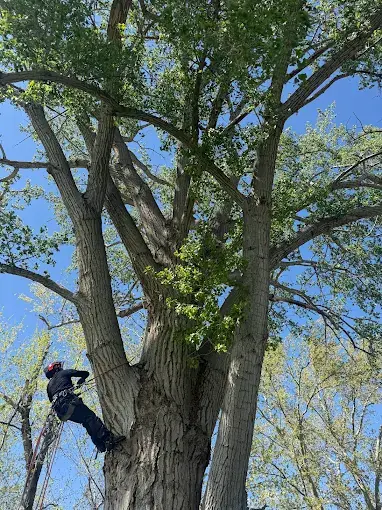
We climb these rather than working from a bucket wherever access allows, since a climber can see cracks and included bark in the upper canopy that ground-level inspection misses entirely.
Windbreak rows still doing their job
Not every Lombardy poplar row on Highway 224 or Demoss Road is ready for removal. Some just need thinning and canopy cleanup to keep doing their job blocking basin wind without becoming a hazard themselves. We'll tell you which is which rather than pushing a bigger job than the trees actually need.
Russian olive along irrigation canals gets a different treatment — hedge-style pruning to keep it off canal banks and fence lines without a full clearing job, when trimming alone is enough to manage it.
Pruning around Red Mountain vineyards
Trees bordering vineyard blocks need clearance pruning that doesn't shade the vines or interfere with equipment passes down the rows. We work these on the same harvest-and-pruning calendar the vineyard runs on, so our crew and the vineyard crew aren't crossing paths during the busiest weeks of the year.
Ornamental and shade trees near tasting rooms and event spaces get treated like the front-facing assets they are — structural pruning that keeps the shape guests expect while cutting out the deadwood and hazard limbs underneath.
Homestead walnuts and wind exposure
Mature walnut trees at Old Benton City homesteads are worth the extra care. Structural pruning reduces the leverage that open basin wind puts on heavy limbs, extending the life of a tree that's often older than the house next to it and just as much a fixture of the property.
Kiona and Old Benton City shade trees
Kiona and the older lots around Old Benton City carry shade trees that predate most of the surrounding ag development — mature specimens set close to houses and property lines instead of out in open ground. Pruning here is less about wind-loading reduction and more about clearance: keeping limbs off rooflines, driveways, and the kind of tight side-yard spacing you don't see out on the acreage. We climb these carefully since ladder access is often blocked by fencing or outbuildings that came later than the tree did.
We also keep an eye out for included bark and old topping cuts on these older trees — decisions made decades ago that still shape how a tree needs to be pruned today. A tree that was topped once tends to need ongoing corrective pruning rather than a single fix.
Working near Horn Rapids Dam and river-corridor trees
Trees along the river corridor near Horn Rapids Dam get pruned with an eye on root stability as much as canopy shape. A tree with a compromised root plate from years of bank erosion or seasonal flooding needs a lighter touch — less canopy removed at once — so it isn't asked to recover from major cuts while also fighting for footing in soft ground.
Recreational access near the dam also means these trees get more foot traffic underneath them than a typical rural property. We prune for overhead clearance on trails and access paths the same way we would over a driveway, since a low, cracked limb over a walking path is as much a liability as one over a car.
Timing pruning around irrigation cycles
Irrigation-dependent trees on sandy soil respond differently to pruning depending on the season. We're more conservative about how much live canopy we remove late in the season, after irrigation has been cut back, than we are earlier when trees have more reserve to recover from cuts.
Common Tree Trimming & Pruning Jobs In Benton City.
Looking For A Tree Company That Actually Shows Up?
You're in the right place. No no-shows. No sketchy bids. No mess left behind — just a hard-working Tri-Cities crew that treats your property like our own.
See why Tri-Cities homeowners choose Berserker.
Can you trim trees around active vineyard rows without damaging vines?
Yes. We work carefully around vine rows and irrigation lines, and we can schedule the work outside of pruning or harvest weeks if the vineyard needs that.
How do you decide if a windbreak poplar needs trimming or full removal?
We look at trunk condition, canker, and lean. If the tree is still structurally sound, thinning and deadwood removal can keep it working as a windbreak for years longer.
Do sandy Benton City soils affect how you approach pruning?
Yes. Sandy, irrigation-dependent root systems mean we're more conservative about how much canopy we remove in one visit, since a stressed root system can't always support a heavily thinned crown right away.
Other Work We Do In Benton City.
Tree Trimming & Pruning Close By.
Got A Tree?
Consider It Handled.
Free estimates. Same-week scheduling on most jobs. Emergency calls answered any hour.
- Free On-Site Estimates
- Licensed, Bonded & Insured
- 24/7 Storm Response
- Cleaner Than We Found It