Pruning Prosser's Historic Shade Trees and Vineyard Windbreaks
A lot of Prosser's best trees are old — downtown elms and maples that have been there longer than most of the buildings around them. They don't need aggressive cuts. They need careful, structural pruning that keeps them standing. We prune to ANSI A300 standards on every job, downtown or out in the vineyards, and we treat a hundred-year-old shade tree with more patience than a younger tree that can shrug off a rough cut. Getting the cuts right the first time matters more here than almost anywhere else we work.
Preservation pruning, not reduction
Our local notes on Prosser are blunt about this: historic-tree care means preservation pruning, not aggressive reduction. A hundred-year-old downtown elm doesn't respond well to heavy cuts. We remove deadwood, correct weak crotches, and thin selectively so wind moves through the canopy instead of catching it, which is often the difference between a tree that survives another Horse Heaven windstorm and one that doesn't.
Spring frost is a real factor here — it cracks older limbs that already carry stress from decades of growth. Part of our pruning work is finding those cracked or weakened limbs before they fail on their own schedule.
Silver maple deadwood in older neighborhoods
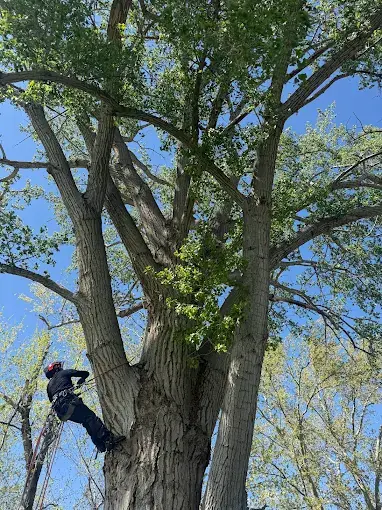
The historic-neighborhood silver maples around Prosser are prone to dropping deadwood as they age. We climb these regularly to clear dead limbs over driveways, sidewalks, and roofs before they come down on their own. It's routine maintenance, but it matters — a big silver maple limb doesn't give much warning before it lets go, and these older trees often carry more deadwood higher in the canopy than it looks like from the ground.
Vineyard windbreak management
Younger Lombardy poplar windbreaks along the Lower Yakima Valley need different care than the old downtown trees — mostly shaping and thinning to keep them functioning as a wind barrier without letting them get top-heavy or crowd the vine rows. We manage windbreaks on a schedule if you'd rather not think about it every season, and we flag any tree that's declining faster than the rest of the row before it becomes a removal.
Pruning around Snipes Mountain and Wine Village plantings
Newer trees planted around Wine Village and Snipes Mountain properties need a different kind of attention than the century-old downtown elms — early structural pruning while they're young, so they grow into a strong shape instead of needing corrective work later. Getting this right in the first few years saves a lot of trouble down the road.
Working around Prosser's wind exposure
Fall and winter wind off the Horse Heaven Hills is hard on trees that haven't been pruned to shed wind. Crown thinning reduces the sail effect on a big canopy, which is one of the most useful things we can do for a downtown shade tree or a ranch-yard tree heading into winter.
Trees along the Yakima River and Old Inland Empire Highway
The route between Prosser and the surrounding vineyards runs past a mix of river-bottom growth and older farmstead plantings along Old Inland Empire Highway. Trees this close to the Yakima River corridor deal with different stress than downtown ones — wetter root zones part of the year, then the same dry summer heat as everywhere else in the valley. We look at root-zone moisture and canopy density together when deciding how hard to thin a tree out here.
Black locust trees planted around old farmsteads along this stretch have a habit of sending up dense root suckers and crowding their own canopy. Thinning those out periodically keeps the main tree healthier and cuts down on the volunteer growth that otherwise takes over a fence line.
Why pruning schedule matters more on older trees
A young tree can go a few years between prunings without much consequence. A hundred-year-old downtown elm can't — deadwood accumulates, weak unions get worse, and a small problem left alone becomes a bigger one. We recommend a standing schedule for Prosser's oldest trees rather than waiting for something to look obviously wrong, since the obvious sign is often a branch already on the ground.
Common Tree Trimming & Pruning Jobs In Prosser.
Looking For A Tree Company That Actually Shows Up?
You're in the right place. No no-shows. No sketchy bids. No mess left behind — just a hard-working Tri-Cities crew that treats your property like our own.
See why Tri-Cities homeowners choose Berserker.
Will you top my old downtown Prosser tree to make it smaller?
No. Topping ruins the structure of a mature tree and creates weak, fast-growing regrowth. For historic Prosser trees especially, we use crown reduction and thinning instead.
How often should a vineyard windbreak be pruned?
Most windbreak rows benefit from a check every year or two — enough to catch overcrowding or storm damage before it becomes a bigger removal job.
Can pruning actually save a cracked limb instead of removing the whole tree?
Often, yes. If the crack is isolated to one limb and the rest of the tree is sound, removing just that limb can extend the tree's life significantly.
Do you prune around Prosser's grape harvest schedule?
Yes. Tell us your picking window and we'll schedule windbreak or vineyard-adjacent pruning around it.
Other Work We Do In Prosser.
Tree Trimming & Pruning Close By.
Got A Tree?
Consider It Handled.
Free estimates. Same-week scheduling on most jobs. Emergency calls answered any hour.
- Free On-Site Estimates
- Licensed, Bonded & Insured
- 24/7 Storm Response
- Cleaner Than We Found It