
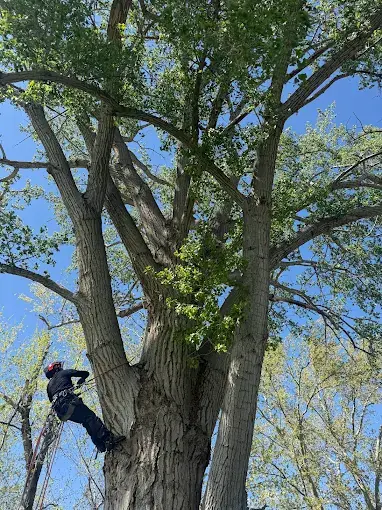
Tree Trimming & Pruning in Kennewick, WA
Kennewick's Austrian pines and red maples grow fast and lean hard into whatever's downwind. Regular trimming keeps limbs off Canyon Lakes rooflines and Southridge sidewalks clear, and it's a lot cheaper than an emergency call after a summer windstorm.
Roof clearance on Canyon Lakes ranches
Single-story ranch homes throughout Canyon Lakes sit close to mature Austrian pines, and low branches loaded with pitch and needles end up resting on the shingles. We climb and cut back to the branch collar, not stub cuts, so the tree keeps growing the way it should instead of throwing up a thicket of weak regrowth right where the problem branch used to be.
Sidewalk and street clearance in Southridge
Red maples planted along Southridge streets are common, and as they mature the lower canopy starts crowding sidewalks and driveways. A crown raise opens that clearance without taking the tree's shape apart — we're lifting the bottom of the canopy, not hacking the top off.
Trimming for wind, not just looks
Kennewick sits downwind of Horse Heaven Hills, and southwest gusts hit hardest on trees with dense, top-heavy canopies. Thinning the crown on globe willows and Austrian pines lets wind pass through the canopy instead of loading up against it, which cuts down on limb failure during summer microbursts.
Bradford pears need a different approach — aggressive structural pruning early can sometimes head off the trunk splits they're known for, though a heavily co-dominant pear may be better off replaced than repeatedly propped up with pruning.
Working in tight backyards
Creekstone and Hansen Park lots tend to be fenced and landscaped tight to the property line. Our climbers work from rope and saddle rather than staging a bucket truck across the lawn, so pruning happens without driving equipment over irrigation lines or flower beds.
Timing pruning to the season
Most Kennewick shade trees prune best while dormant in late winter, before spring growth kicks in and before Austrian pines start running pitch. Waiting until a limb is already resting on a roof or fence means reactive work instead of planned maintenance — and reactive trims are harder to do cleanly.
Red maples and globe willows both respond well to a late-winter structural check, catching weak unions or early rot before a Horse Heaven wind event turns a small problem into a bigger one.
When trimming isn't enough
Not every problem branch is a pruning job. A globe willow with advanced crown rot, or a Bradford pear with a deep bark-included union, may be past the point where trimming meaningfully reduces the risk. We'll say so directly rather than billing for a trim that won't hold up through the next windy season.
What a Kennewick trim job looks like start to finish
We walk the tree with you first, point out deadwood, crossing limbs, or clearance issues, and agree on what's coming off before anyone climbs. Cuts are made at the branch collar per ANSI A300 standards, never flush and never a stub, so the tree heals correctly.
When we're done, brush is chipped or hauled and the lawn is blown clean. Most residential Kennewick trims — a single Austrian pine or a pair of street maples — wrap up in a single visit. We also check for included bark and weak branch unions while we're up there, since those are the failure points that show up first when a Horse Heaven gust catches a heavy limb.
No topping, on any Kennewick tree
Topping looks like a quick fix for a pine crowding a Canyon Lakes roofline, but it isn't one. Topped trees respond with a thicket of weak, fast-growing suckers right at the cut — exactly the kind of unstable regrowth that snaps off in the next Horse Heaven wind event. We reduce height with proper reduction cuts back to a lateral branch instead, so the tree keeps a natural shape and doesn't grow itself back into the same problem within a couple of seasons.
Vista Field and Highlands: shaping young trees right
Newer plantings around Vista Field and the Highlands are still building their structure, and that's the cheapest time to get it right. A young red maple or Austrian pine that gets a structural prune in its first few years rarely needs corrective work later — we remove competing leaders and low crossing limbs while the cuts are small, instead of waiting until a co-dominant stem is thick enough to split in a summer storm.
We keep live-wood removal to a sensible limit in any single visit, generally under a quarter of the canopy, so a young tree isn't set back by an overly aggressive first prune. That pacing matters more in Kennewick's sandy soils, where a stressed root system doesn't recover as quickly as it would in heavier ground.
Common Tree Trimming & Pruning Jobs In Kennewick.
Looking For A Tree Company That Actually Shows Up?
You're in the right place. No no-shows. No sketchy bids. No mess left behind — just a hard-working Tri-Cities crew that treats your property like our own.
See why Tri-Cities homeowners choose Berserker.

Will trimming stop my Bradford pear from splitting?
It can help if caught early, by removing competing co-dominant stems. Once a pear is mature and heavily forked, pruning alone often isn't enough to prevent a future split.
How often should Canyon Lakes pines be trimmed for roof clearance?
Every two to three years is typical for a mature pine close to a roofline, though fast growers may need it sooner.
Can you trim without driving equipment onto my lawn?
Yes. Most Kennewick trimming jobs are done entirely from a climber on rope, so nothing heavy crosses your turf or beds.
Do you trim globe willows or just remove them?
Both, depending on condition. If crown rot has already set in, hazard pruning to remove dead wood may only buy time — we'll tell you straight if removal makes more sense.
Other Work We Do In Kennewick.
Tree Trimming & Pruning Close By.
Got A Tree?
Consider It Handled.
Free estimates. Same-week scheduling on most jobs. Emergency calls answered any hour.
- Free On-Site Estimates
- Licensed, Bonded & Insured
- 24/7 Storm Response
- Cleaner Than We Found It