Tree Trimming & Pruning for Richland Yards
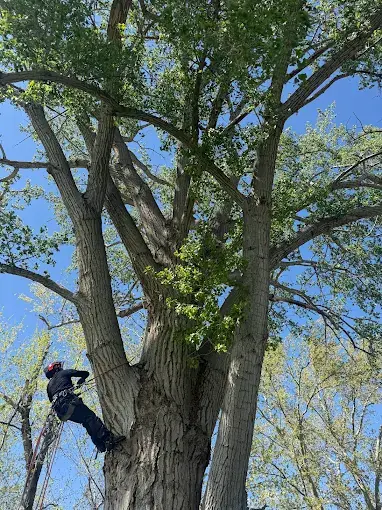
Richland's honeylocust street trees and backyard blue spruces don't need a haircut so much as a plan. We prune to ANSI A300 standards on every job — no topping, no flush cuts — because a tree pruned wrong this year is a bigger problem in three.
Honeylocust street trees
Because honeylocust is planted so densely along certain Richland subdivisions, we often prune an entire block of street trees in a single visit — matching the crown-raise height across neighboring trees so the street reads as a uniform, well-kept row rather than a patchwork of different pruning styles.
Honeylocust is one of the most common street trees planted along Richland sidewalks and driveways, and it's also one of the easiest to prune wrong. Left alone, low branches crowd sidewalks and driveway clearance disappears within a few seasons. We raise the crown for clearance while keeping the natural shape — no lion-tailing, no stub cuts.
Blue spruce limb management
Spacing between spruces planted close together in older Richland yards also matters — when two mature spruces grow into each other, selective thinning on the interior side keeps both trees healthy instead of one shading the other into decline.
We also watch for pitch and resin buildup on Richland spruces after a hot, dry stretch — a sign the tree is stressed and shedding sap to seal off damage. That's usually a cue to schedule a health-focused prune rather than wait for a full limb failure.
Colorado blue spruces are everywhere in Meadow Springs and the Gold Coast, and their lower limbs are heavy enough to sag onto a roofline within a decade of planting. We selectively remove and reduce those lower limbs before they're resting on shingles, which is a lot cheaper than dealing with roof damage or a full removal later.
Deadwood is also a bigger issue than most homeowners expect on Richland spruces — the dry, low-humidity summers here dry out limb tips fast, and dead wood inside a dense spruce canopy is invisible until it falls.
Silver maple structure work
New Badger Mountain South and Westcliffe plantings benefit most from a light structural prune every year or two for the first five years — small, early corrections that take a fraction of the time a mature tree's structural problems take to fix later.
For Richland homeowners who inherited a mature silver maple instead of planting a young one, structural pruning still has a role — reducing end-weight on long horizontal limbs lowers the leverage that causes crotch splits, even on a tree that's already decades old.
Silver maples grow fast and split easy — that's just the wood. Structural pruning on younger Richland silver maples, especially in Westcliffe and Badger Mountain South's newer plantings, sets the branch spacing early so the tree doesn't develop the same split-crotch problems as the mature maples we remove elsewhere in town.
Timing around Richland's climate
Wind is as much a factor in our pruning decisions as the calendar. A canopy left too dense heading into Richland's windy spring stretch acts like a sail; thinning it out reduces the load on the trunk and root plate during the season when gusts are strongest.
Fruit trees around older Richland properties, especially near the original Gold Coast lots, need a different calendar entirely — winter structural cuts and a lighter summer pass for size control. We treat fruit trees on their own schedule rather than lumping them in with ornamental pruning.
Late winter dormancy is the best pruning window for most Richland species before the summer heat and wind arrive. We also work around Richland PUD clearance needs when a tree is growing into a line — clearance pruning there is coordinated so a homeowner isn't caught between us and the utility.
Common Tree Trimming & Pruning Jobs In Richland.
Looking For A Tree Company That Actually Shows Up?
You're in the right place. No no-shows. No sketchy bids. No mess left behind — just a hard-working Tri-Cities crew that treats your property like our own.
See why Tri-Cities homeowners choose Berserker.
My blue spruce's bottom branches are touching the roof — is that trimmed or removed?
Usually trimmed. We selectively remove or reduce the offending lower limbs rather than taking the whole tree, unless the spruce is already leaning or structurally compromised.
Can you prune my honeylocust without ruining its shape?
Yes — crown raising for sidewalk and driveway clearance keeps the natural canopy shape. We're not stripping the tree, just lifting the bottom of it.
Is there a bad time of year to prune trees in Richland?
Late winter dormancy works best for most species here. We'll tell you if your specific tree has a narrower window.
Do you handle pruning near Richland PUD power lines?
Yes, and we coordinate with PUD directly rather than pruning blind near a primary line.
Other Work We Do In Richland.
Tree Trimming & Pruning Close By.
Got A Tree?
Consider It Handled.
Free estimates. Same-week scheduling on most jobs. Emergency calls answered any hour.
- Free On-Site Estimates
- Licensed, Bonded & Insured
- 24/7 Storm Response
- Cleaner Than We Found It