
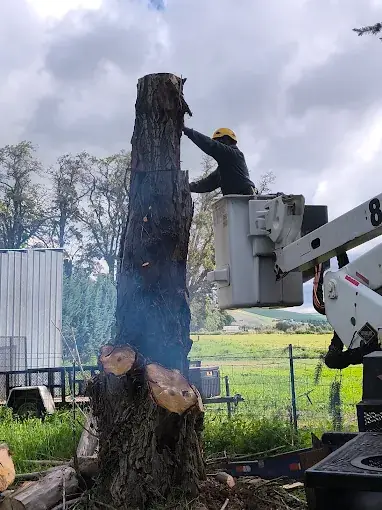
Stump Grinding in Kennewick, WA
A leftover stump in a Southridge yard means one less usable square foot of patio or pool deck. We run compact grinders that fit through a standard Kennewick backyard gate, so we can grind six inches below grade without pulling a fence panel or tearing up the lawn getting there.
Clearing the way for pool and patio work in Southridge
Southridge homeowners doing pool or patio construction usually need a stump gone completely, not just cut flush. We grind well below the finished grade line so a contractor can pour concrete or lay pavers right over the spot without hitting old root wood.
Fence-line stumps in Creekstone and Hansen Park
Old fence-line trees leave stumps and surface roots that make new fence installation a headache. We grind both the stump and the spreading surface roots so a contractor can set posts without hitting buried wood, and so mower blades in that stretch of yard don't take the hit either.
Right-sized equipment for tight lots
Canyon Lakes and Vista Field backyards are typically fenced and landscaped, with a single narrow gate as the only entry point. Our 35-inch grinders and mini-loaders are sized specifically for that — no wider machines that require dropping a fence section to get in.
Protecting what's already there
Sandy Kennewick soils throw grindings and chips further than heavier clay soils would, so we tarp and shield pavers, turf, and irrigation heads before we start. Chips get hauled off or raked back into the hole, whichever you'd rather have.
One trip instead of two
If we're already removing a tree in Canyon Lakes or Southridge, grinding the stump the same day means one mobilization instead of two — no second trip through the same gate, no second round of tarping. Most customers combine the two jobs for exactly that reason.
Ready for what comes next
A ground stump in a Vista Field or Highlands yard means the space is actually usable again — for sod, a new planting bed, a shed pad, or just a lawn without a tripping hazard in the middle of it. We rake the area level when we're done so it's ready for whatever's next, not just cleared.
What to expect on grinding day
We start with a standard 811 utility locate before any grinding begins, even on a small residential stump — Kennewick's sandy soils don't offer much resistance, but buried lines still need to be found first. Then it's just the grinder, working the stump down below grade in one pass.
Most single-stump jobs in Canyon Lakes or the Highlands wrap up in under an hour once equipment is on site. Multiple stumps on the same property go faster per-stump than scheduling separate visits. If access is tighter than expected once we arrive — a locked side gate, a parked trailer, sprinkler heads right at the drip line — we adjust the approach on site rather than rescheduling the job.
Highlands and hillside lots
Older Highlands properties sit on more uneven ground than the newer flat pads in Southridge or Vista Field, and a stump on a slope grinds differently than one on level lawn. We set the grinder for stable footing before we start, working the machine at an angle that still gets consistent depth across the stump instead of leaving a shallow high side.
Chips: haul off or backfill, your call
Some Kennewick homeowners want the ground stump backfilled with its own chips, since they settle into the hole over a few weeks and save a trip to the dump. Others want the whole mess gone the same day, especially ahead of sod or a paver install where loose chips in the base layer would just cause problems later. We ask before we start rather than assuming.
Bradford pears and globe willows: two different grind jobs
A Bradford pear removed after a trunk split usually leaves a wide, shallow root flare that spreads further than the trunk width suggests — we grind past the visible stump edge to catch those flares before someone hits one with a shovel next spring. A globe willow's root system tends to run shallower still, especially in sandy Kennewick soil, and grinds faster but often needs a wider pass to get every surface root a mower blade would otherwise catch.
Common Stump Grinding Jobs In Kennewick.
Looking For A Tree Company That Actually Shows Up?
You're in the right place. No no-shows. No sketchy bids. No mess left behind — just a hard-working Tri-Cities crew that treats your property like our own.
See why Tri-Cities homeowners choose Berserker.
Can your grinder fit through my Southridge side gate?
In most cases, yes. Our compact 35-inch grinders are built for standard residential gate widths — we'll confirm access when we quote the job.
How deep do you grind for a pool deck pour?
Below the contractor's finished grade, typically at least six inches down, sometimes deeper depending on what's being built over it.
What happens to the stump grindings?
You choose — we can backfill the hole with the ground material or haul every bit of it off-site, especially useful before a concrete pour.
Will grinding damage my irrigation lines?
We locate and tarp irrigation heads and lines before grinding. Let us know where they run and we'll work around them.
Other Work We Do In Kennewick.
Stump Grinding Close By.
Got A Tree?
Consider It Handled.
Free estimates. Same-week scheduling on most jobs. Emergency calls answered any hour.
- Free On-Site Estimates
- Licensed, Bonded & Insured
- 24/7 Storm Response
- Cleaner Than We Found It