Tree Removal in Pasco, WA — Windbreaks, River Bluffs, and New Subdivisions
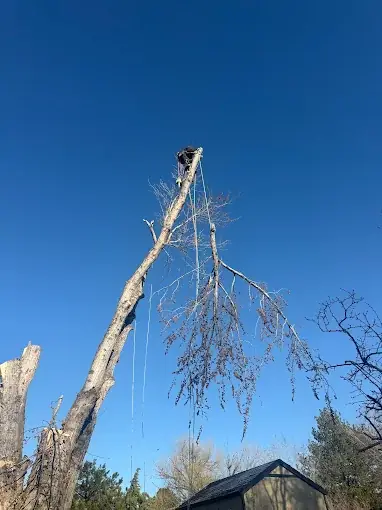
Pasco doesn't have one kind of tree problem — it has three. Aging Lombardy poplar windbreaks failing on ag land, storm-snapped cottonwoods along the river bluffs, and the odd hazard tree in a brand-new Broadmoor yard. We remove all three the same way: rigged down clean, piece by piece, never dropped free over a fence, a driveway, or a neighbor's roof.
The Road 68 and Road 100 windbreak problem
Most of the Lombardy poplar rows out past Road 68 and Road 100 went in during the 70s and 80s to break the wind on open ag ground. Thirty and forty years later, those same trees are hollow, canker-scarred, and dropping limbs the size of fence posts without much warning. May through August is when they fail hardest — dry wood, hot Columbia Basin wind, and root systems that have been irrigation-dependent for decades and don't hold up well once that support changes.
We take these down row by row with a crew and equipment sized for the job, not a single-tree setup that would take a week to finish a windbreak. That usually means a bucket truck or climber working the row in sequence, a chipper keeping pace behind them, and a dump trailer staged for haul-off so the property isn't buried in brush by lunchtime.
Russian olive and black locust removal
Russian olive spreads fast across Pasco's irrigation canals and fence lines, and it fights back with thorns the whole way down. It's rarely a single tree — usually a thicket that's taken over a stretch of fence line or canal bank over several seasons, and clearing it means cutting and hauling a lot of low, tangled growth rather than one clean trunk.
Black locust isn't much friendlier. It's tough wood that splits in directions you don't expect, especially on older trees around Pasco farmsteads that have grown wide and lopsided over the decades. Both species need a crew that reads how the wood is going to move before the saw ever touches bark, not one that finds out halfway through the cut.
Broadmoor, Three Rivers, and Riverview removals
Newer Pasco neighborhoods bring a different kind of job: a single hazard tree — often a young honeylocust with a bad lead, a storm-stressed tree planted too close to a foundation, or something a landscaper put in the wrong spot years ago. These lots are tighter, the trees are smaller, and there's more to protect around them: sprinkler heads, new sod, vinyl fencing, and neighbors close enough to matter.
We treat these with the same rigging standards as a big ag removal, just scaled down. Ropes control the drop, tarps protect the lawn and beds, and the crew works methodically instead of rushing because the tree happens to be smaller.
River bluff and storm cleanup
Trees along the Snake and Columbia bluffs deal with erosion-stressed root plates on top of everything else Pasco throws at a tree. When wind or a wet spring topples one, the ground underneath it is often already unstable, which changes how we set up equipment and rigging before we ever start cutting.
We get the downed or leaning tree off the bluff and out of the water's way without adding more disturbance to a bank that may already be sliding. That sometimes means working from above with ropes rather than driving equipment right up to the edge.
What happens to the wood
We run a 12-inch industrial chipper on every Pasco job, so there's no burn pile smoldering in your side yard for a week afterward and no county burn-permit headache to deal with. Rural and ag haul-off is priced per load rather than per stump, which matters a lot when you're clearing forty poplars instead of a single backyard tree — you're not paying a per-tree markup for volume work.
Common Tree Removal Jobs In Pasco.
Looking For A Tree Company That Actually Shows Up?
You're in the right place. No no-shows. No sketchy bids. No mess left behind — just a hard-working Tri-Cities crew that treats your property like our own.
See why Tri-Cities homeowners choose Berserker.
Can you remove an entire windbreak row, not just one tree?
Yes — that's one of the most common calls we get out of the Road 68 corridor. We size the crew and chipper to the row, not to a single tree, so a 30-tree windbreak doesn't turn into a month of visits.
Do you charge extra for ag or rural Pasco properties?
No mileage charge. Rural and ag jobs are priced on scope and haul-off per load, the same flat-quote approach we use on a Broadmoor lot.
My poplar is hollow but still standing — is that urgent?
Treat it as urgent, especially in summer. Hollow Lombardy poplars fail with little warning once wind picks up. Worth a look before it drops on a fence, driveway, or outbuilding.
Do you clear trees near the Snake or Columbia riverbank?
Yes. We're careful with equipment placement on bluff edges since the root plates there are often already erosion-stressed. We'll walk the site with you before anything gets cut.
Other Work We Do In Pasco.
Tree Removal Close By.
Got A Tree?
Consider It Handled.
Free estimates. Same-week scheduling on most jobs. Emergency calls answered any hour.
- Free On-Site Estimates
- Licensed, Bonded & Insured
- 24/7 Storm Response
- Cleaner Than We Found It