Tree Removal in Richland, WA
A cottonwood leaning toward the house after a Columbia Basin windstorm doesn't wait for a convenient week. We're based right here in Richland, and most of our removal calls are the same silver maples, blue spruces, and river-bottom cottonwoods we've been climbing for years — not strangers.
The trees we take down most in Richland
Split limbs on Gold Coast silver maples rarely announce themselves ahead of time — a crack forms in the crotch, holds for a season or two under its own weight, and lets go during the next heavy wind or wet snow. By the time a homeowner calls us, the tree usually needs to come down rather than be saved with cabling, and we'll tell you plainly which situation you're in before we ever start cutting.
Silver maples in the older Gold Coast neighborhoods split at the crotch as they age — brittle wood, heavy limbs, and not much warning before a chunk comes down on a fence. Colorado blue spruces in Meadow Springs and the Gold Coast grow top-heavy and lean once the lower limbs start sagging onto rooflines, and at that point removal beats fighting gravity every season.
Cottonwoods along the Columbia near Columbia Point and the Hanford Reach shoreline are the biggest hazard calls we get. Limb drop is constant on a mature cottonwood, and once one starts shedding whole sections, it's not a pruning job anymore.
Working around PUD lines and tight yards
We've mapped enough Richland backyards over the years to know which blocks in the original Gold Coast grid run PUD service through the rear property line instead of the front, which changes how we stage rigging and where the drop zone can safely sit. That local knowledge saves a homeowner a second site visit just to figure out access.
Richland PUD runs power through a lot of backyards, especially in the older Gold Coast grid and parts of South Richland. We coordinate directly with PUD before any removal near a primary line — we don't guess, and we won't send a climber near an energized conductor without a plan. If the job is a right-of-way tree, we also handle the City of Richland street-tree permit so you don't have to track it down yourself.
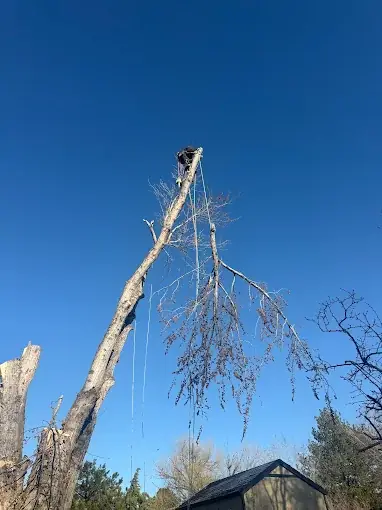
A lot of Richland lots — especially the 1950s Gold Coast blocks — have narrow side yards and mature landscaping packed tight around the trunk. We rig every piece down on rope instead of dropping it, which is the only way to take a 60-foot spruce out of a yard that size without losing a fence or a flower bed in the process.
Storm season and Badger Mountain wind
Badger Mountain South's newer builds sit higher and more exposed than the older river-bottom neighborhoods, so wind-driven damage there tends to hit young, thin-trunked trees rather than old growth. We treat those calls differently — often it's one compromised tree rather than a whole yard's worth of deadwood, but speed still matters before the next gust finishes the job.
Prevailing southwest wind gusts hit hardest across Badger Mountain South and the Plateau, and that's where we see the most leaning conifers after a wind event. If a tree is already compromised, we get eyes on it fast — a leaning blue spruce over a driveway in Badger Mountain South doesn't get better with time.
Cleanup and haul-off
We also offer to leave firewood-length rounds behind for homeowners who want them — a lot of removed cottonwood and maple in Richland ends up split for backyard fire pits rather than hauled to the dump, which cuts down on disposal trips for us and gives you usable wood.
Every removal ends with the wood hauled, the chips blown out, and the lawn raked — Meadow Springs and Westcliffe HOAs expect a clean site, and we treat every job that way whether there's an HOA watching or not. Stump grinding is available same day if you want the whole thing gone in one visit.
Common Tree Removal Jobs In Richland.
Looking For A Tree Company That Actually Shows Up?
You're in the right place. No no-shows. No sketchy bids. No mess left behind — just a hard-working Tri-Cities crew that treats your property like our own.
See why Tri-Cities homeowners choose Berserker.
Will you drop a tree over my fence to save time?
No. We rig and lower every piece on rope. Richland's older lots don't have room for a fence to be an acceptable loss, and we don't treat it that way.
My blue spruce leans over my neighbor's driveway in Meadow Springs — can you still take it down safely?
Yes. That's a common call in Meadow Springs and the Gold Coast. We set rigging to control the direction of every piece, so a lean toward a neighbor's property doesn't dictate where the wood ends up.
Do you need my permission to talk to Richland PUD about a tree near their lines?
We'll ask for it, but we always loop PUD in directly rather than working blind near a primary line. It's a phone call, not a delay, on most jobs.
Is a cottonwood near the Columbia River harder to remove than a yard tree?
Usually bigger, not harder. River-bottom cottonwoods near Columbia Point run large, so we plan the rigging and drop zone around the size, not the location.
Other Work We Do In Richland.
Tree Removal Close By.
Got A Tree?
Consider It Handled.
Free estimates. Same-week scheduling on most jobs. Emergency calls answered any hour.
- Free On-Site Estimates
- Licensed, Bonded & Insured
- 24/7 Storm Response
- Cleaner Than We Found It