
24/7 Emergency Tree Service in Pasco — Windbreak Failures, River Bluff Storms
Pasco's emergencies have a pattern: a hollow Lombardy poplar going down in a May wind event, or a river-bluff tree letting go after a wet spring loosens the bank underneath it. When it happens on your property, day or night, we answer the phone ourselves and we come.
Windbreak failure season
May through August is when Pasco's aging poplar windbreaks fail hardest. Dry wood and Columbia Basin wind gusts on open ag land are a bad combination for a 40-year-old row nobody's inspected in a decade, and the failures tend to come in clusters during the worst wind events rather than spread evenly through the season.
When one goes down across a driveway, fence, or outbuilding, we treat it as the emergency it is, not a next-week callback. Open ag lots also mean there's often nothing else nearby to slow a falling tree down before it reaches something that matters.
River bluff and confluence-area storms
Properties near the Snake and Columbia confluence deal with erosion-stressed trees that can let go with a storm or a saturated bank, sometimes with very little visible warning beforehand. We get in carefully, secure what's unstable, and remove the hazard without adding more disturbance to a slope that may already be moving.
Open-lot wind exposure
Pasco's open subdivisions and ag lots don't have much left to break the wind once the windbreaks themselves start failing — which is exactly when it matters most. That leaves individual trees more exposed than in a denser Kennewick or Richland neighborhood, and a single hard gust can take one down fast, sometimes onto a fence, vehicle, or structure with almost no lead time.
What we do when we arrive
We assess the hazard, secure or remove what's dangerous, and tarp any structural damage the same visit rather than leaving it exposed overnight. Franklin PUD line-clearance coordination happens automatically if a downed tree is anywhere near power lines — we don't touch energized lines ourselves, and we'll tell you straight when PUD needs to be the one on scene before we can safely continue.
Hung-up limbs and widow-makers on ag ground
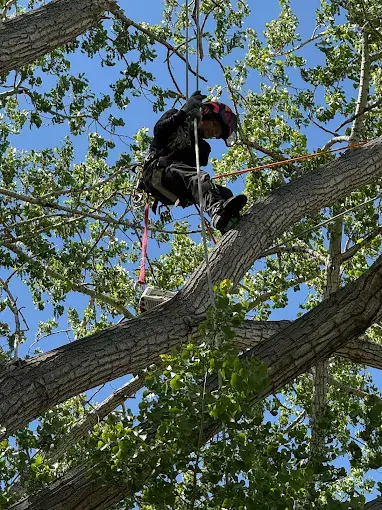
A poplar that snaps mid-trunk in a windbreak row doesn't always come all the way down. It's common to find the top hung up in the row next to it, or a heavy limb wedged overhead and swinging loose in the next gust. Those hung-up sections are some of the most dangerous wood on a Pasco property because they look stable until they're not, and open ag ground gives them room to swing further than you'd expect before landing. We get them down under control with rope and rigging rather than pulling and hoping, which is how a bad situation on a farmstead usually gets worse.
After the crew leaves
An emergency call doesn't always end with the property back to normal that same night. If we've tarped a roof breach or secured a leaning section until daylight, we'll walk you through exactly what's temporary and what still needs a follow-up visit, and we schedule that follow-up before we leave rather than leaving you to call back and start over. On insured jobs, we document everything with photos as we go so there's a clear record for the claim, whether that's storm damage to a Broadmoor home or a windbreak loss on a working ag property.
Why response speed matters more on open ground
A damaged tree sitting exposed overnight is a different risk in Pasco than it is in a sheltered Kennewick backyard. Open ag lots and Road 100 acreage don't have neighboring structures or windbreaks close by to slow down further wind load, so a partially failed poplar or a cracked limb left unaddressed can go from stable to dangerous in the next gust rather than the next storm. That's part of why we treat active hazards here as same-visit work rather than something to schedule around, even when the initial damage doesn't look severe.
Common Emergency Tree Removal Jobs In Pasco.
Looking For A Tree Company That Actually Shows Up?
You're in the right place. No no-shows. No sketchy bids. No mess left behind — just a hard-working Tri-Cities crew that treats your property like our own.
See why Tri-Cities homeowners choose Berserker.
A poplar from my windbreak just came down — how fast can you get here?
For active hazards in Pasco we aim to be on-site quickly, typically within about 90 minutes. Call (509) 410-7904 and we'll give you a straight ETA based on conditions.
Do you handle emergencies on rural Road 68 or Road 100 properties?
Yes, rural and ag calls get the same response as anywhere else in Pasco. Bring us the address and we'll get equipment moving.
What if the downed tree is tangled in a power line?
We stop short of energized lines and coordinate directly with Franklin PUD. We'll still assess the rest of the hazard and get everything else cleared.
Is emergency work near the river bluff more expensive?
No separate fee for the location. We do take more care with equipment placement on bluff edges given the erosion risk, but pricing stays the same straightforward approach.
Other Work We Do In Pasco.
Emergency Tree Removal Close By.
Got A Tree?
Consider It Handled.
Free estimates. Same-week scheduling on most jobs. Emergency calls answered any hour.
- Free On-Site Estimates
- Licensed, Bonded & Insured
- 24/7 Storm Response
- Cleaner Than We Found It